White paper
New Sparker Technology Dramatically Improves Seismic Surveying
- Published
- June 2017
- Pages
- 2
- File
- PDF 2.0 MB
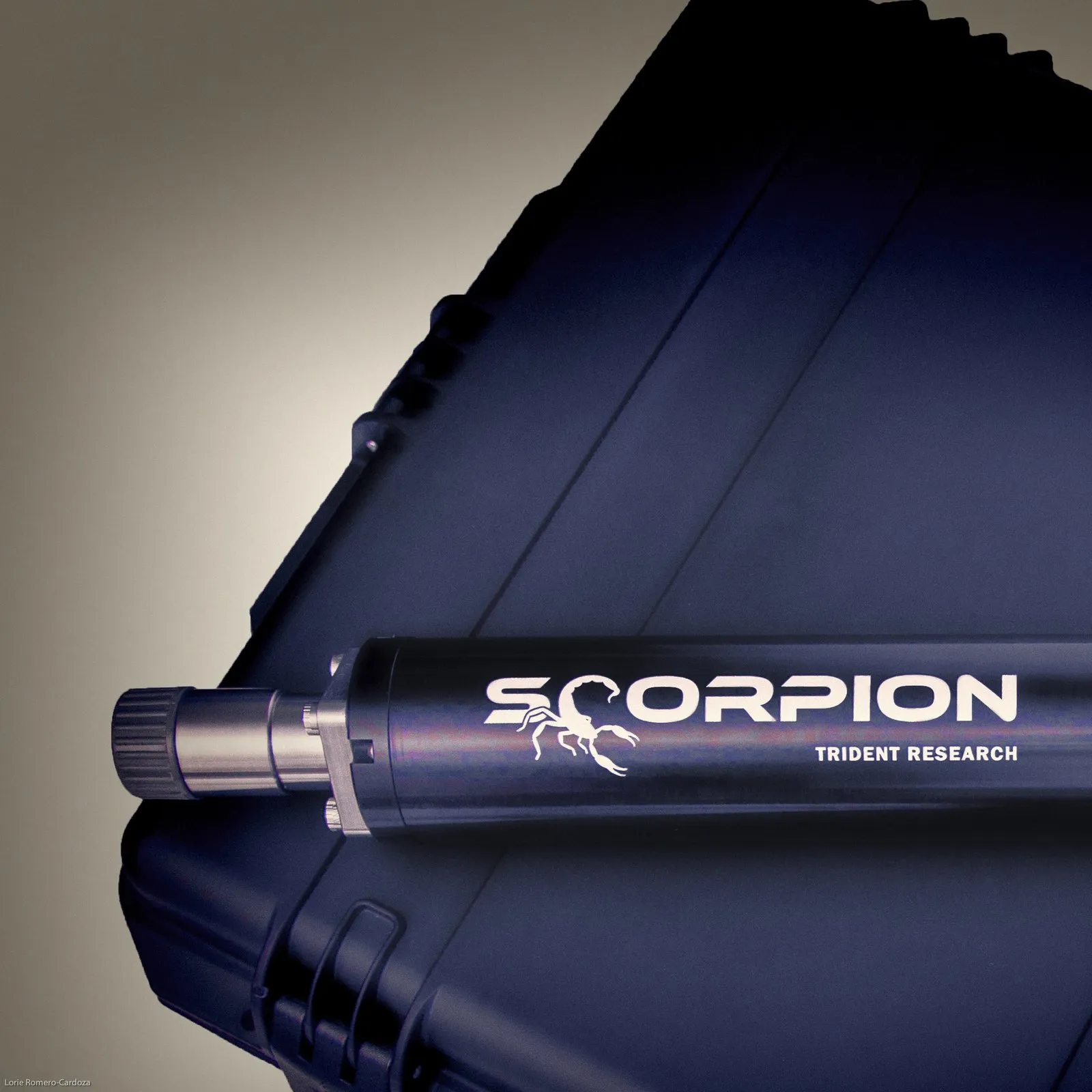
Trident scientists and engineers have invested over 20 years in the design, development, and miniaturization of underwater sparker technology to create a unique, one-of-a-kind reliable seismic surveying product.
Since the early 1950’s, seismologists have been searching for the ideal impulsive sound source. They have tried many different types of devices, some even hand-made. From explosive charges to large machine-driven hammers weighing hundreds of pounds, seismologists have struggled to achieve their ideal sound source; one that would provide significant amplitude pressure waves (P-waves), would provide a repeatable amplitude level, and would be relatively simple to use. If the device were highly portable and less dangerous, then it would be a true breakthrough. Enter sparker technology. Traditional sparkers are complex devices that use massive capacitor banks to store significant electrical energy at high voltage, discharging that energy across an electrode to produce a spark.
At sufficiently high voltages, a plasma arc discharge occurs, vaporizing the water and creating a bubble that expands and radiates a blast of impulsive acoustic energy. Even small sparkers of traditional design employ power supply boxes similar in size and weight to a large suitcase, sending high voltage / high current pulses down cables to one or more remote electrodes. Because of their size (and weight) and a requirement for significant power, they are not very portable, can only be deployed to relatively shallow depths, and pose hazards to the operator.
Trident scientists and engineers have invested their entire careers in modernizing and miniaturizing sparker technology. What was once the size of a refrigerator is now the size of a poster tube. The potentially dangerous high voltage electricity is now safely captive in the lower unit, and the operator is exposed only to low voltage power that can be supplied by a motorcycle battery. Instead of performance that falls off with operating depth, Trident’s sparker can be employed at depths of several hundred feet, producing full power in any deployment scenario. And with precise computer controlled discharge timing, modern data processing techniques like tomography are made possible.
“The amplitude we measured was 50 times more powerful than our old hammer device.”
“The ability to operate in fresh water makes it useful in areas where traditional sparkers cannot operate.”
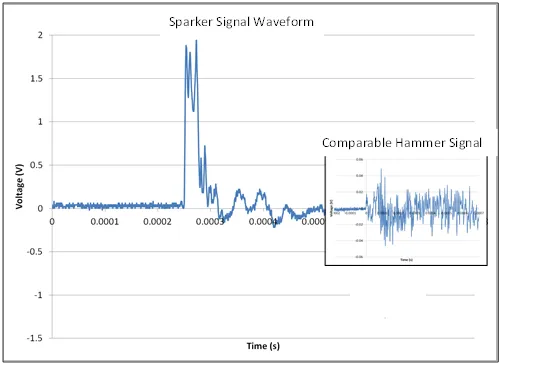
Scorpion™ vs manual hammer
Development of the Scorpion™ bore hole sparker required experimental testing against traditional P-wave sound source devices. One early test was a quantitative amplitude test against a traditional manual hammer sound source. After several test events the results were clear. The Scorpion™ prototype produced 50 times the amplitude of the manual hammer device.
Applying proven military standards to commercial products
Trident Research, itself, is a revolution in productizing advanced technology. The rapidly expanding technology base is not driven by military or space demands, but by consumer grade electronics. Trident exploits these enabling technologies, using DOD systems engineering standards to produce revolutionary products. ISO 9001 manufacturing processes (Cert #55212) ensure that every product meets our Trident Tough standards.
Go Tough. Go Trident. www.tridentresearch.com
Staggering power & maximum portability
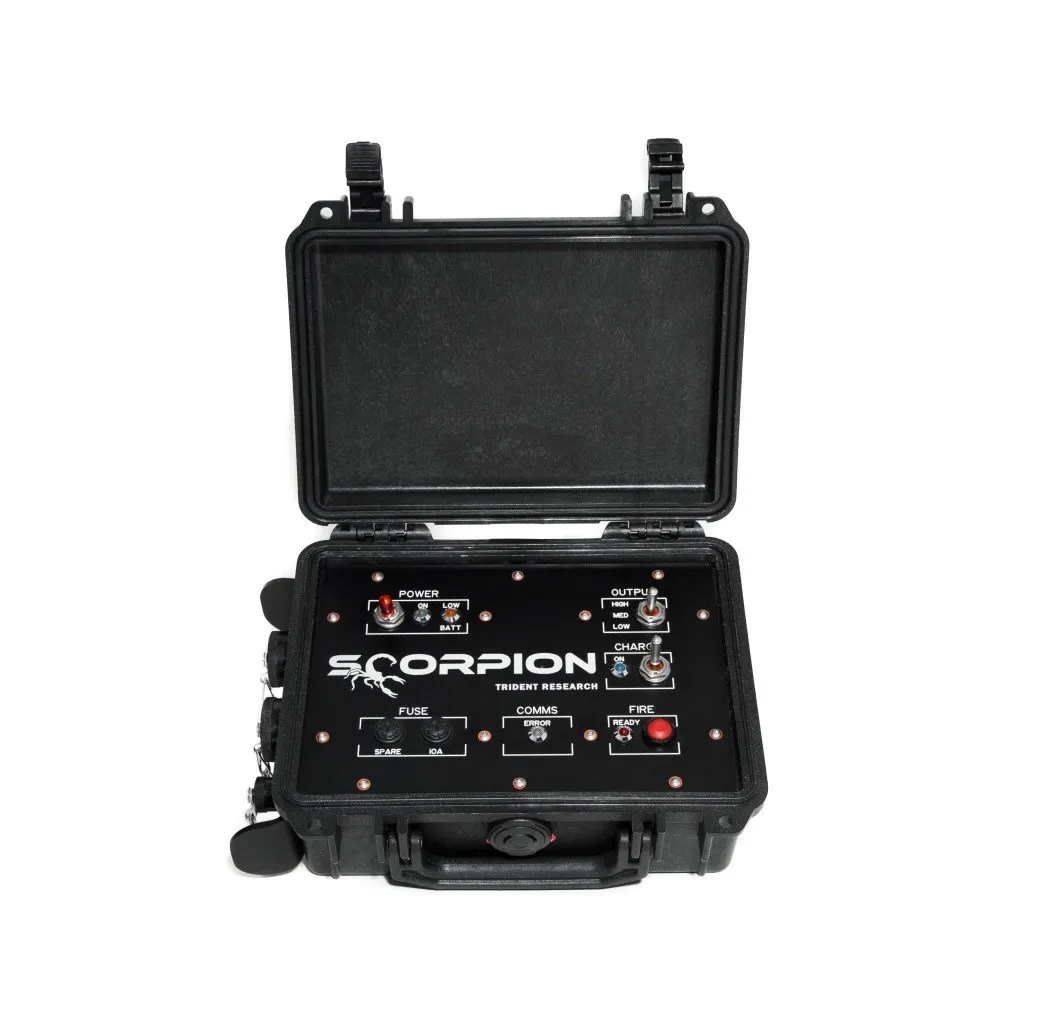
The secret to Trident’s revolutionary Scorpion™ is the logic-controlled pulse electronics and low power charging design. Scorpion™ is designed to output a consistent energy level with every pulse. With all high energy components located in the sparker head, there is no need for high voltage power lines or external capacitor banks. A Scorpion™ can be operated using a simple 12 volt DC battery. Small enough to fit within a 3-inch diameter bore hole, the Scorpion™ minimizes drilling requirements, and with its significant acoustic amplitude, pictured below, supports capture at greater distances, expanding the range of surveys and analyses that can be performed.
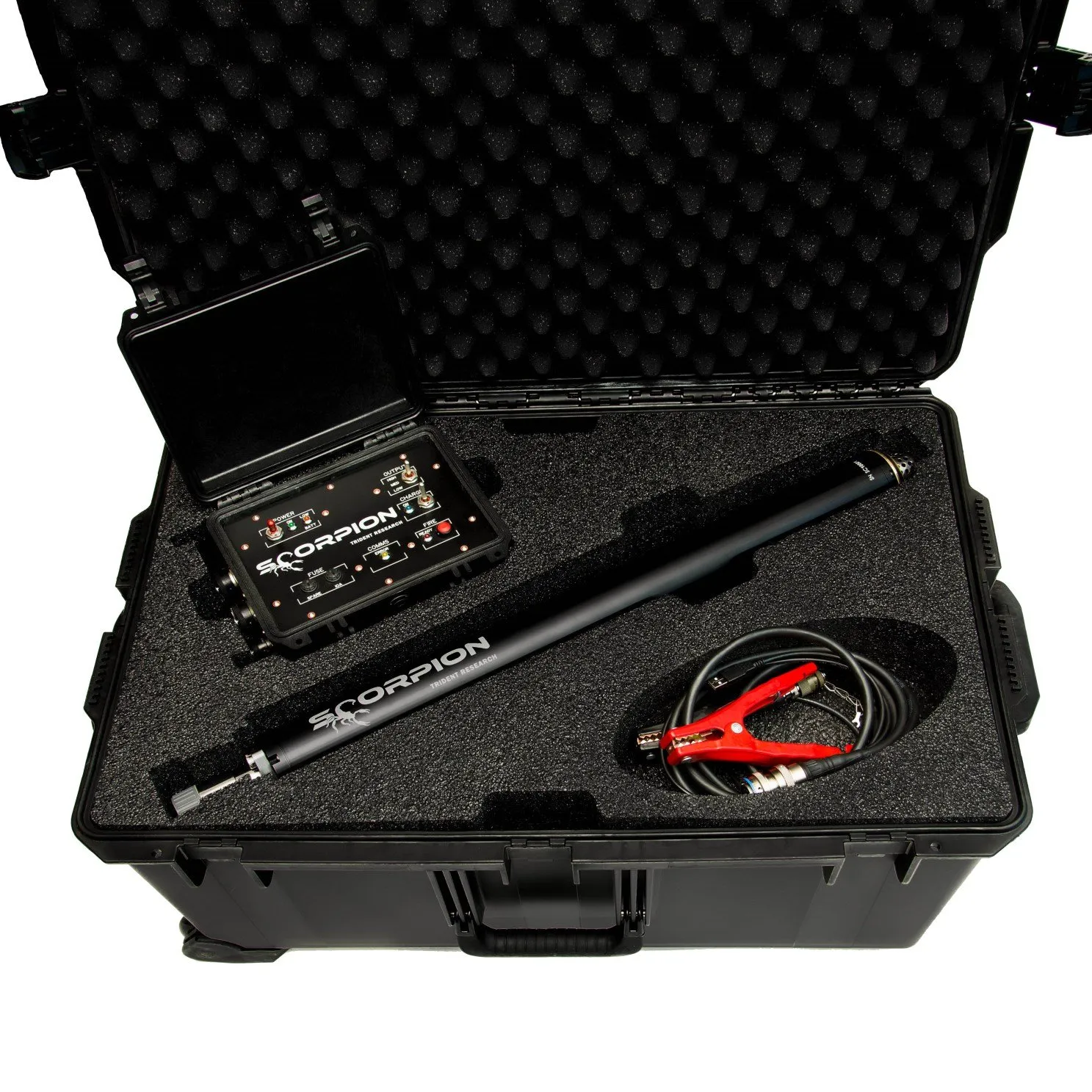
The Scorpion™ releases its energy with sub-millisecond timing. Precise control means multiple Scorpion™ sparkers can be combined to create constructive pulse emissions to maximize energy at a given range or orientation. Multiple Scorpion™ sparkers can be linked in a bore hole line array for seismic tomography or multiple units can be packaged in a towed source array for undersea seismic surveying. Its rugged design is able to withstand pressures of several hundred feet. The simple all-weather control unit is small and lightweight, making Scorpion™ also the most portable and simple to use sparker on the market. In a word-revolutionary.